
Pack a picnic, learn some history and get up close and personal with farm animals at the site where Texas became a nation.
Families can enjoy 293 acres of fun at Washington-on-the-Brazos State Historic Site, a Texas Parks and Wildlife site full of green hills, walking trails and pretty playgrounds, all with enough Texas history to fill young imaginations.
Jon Failor, the complex superintendent, recommends spending at least one full day at the site so your family can see everything starting with the replica of Independence Hall on the spot where 59 Texans signed the Declaration of Independence in 1836. The site also includes Barrington Living History Farm where children can help with some 19th Century chores like driving oxen or making soap.
The site will host a free event March 2 and 3 to commemorate the 183rd anniversary of Texas declaring its independence from Mexico. The festival-like experience will include several stages with medicine shows and Punch and Judy puppet shows and other entertainment from an earlier era.
About 8,000 people attended the Texas birthday party in 2018. A similar number could attend this year.
“If the weather’s good, it will be busy,” Failor said. If your family can’t make it, don’t worry. The site is open all year with so many activities available that you might want to go back more than once.
Independence Hall
On March 1, 1836, Texans wanting to create a new and separate country met during a convention in Washington, a town on the Brazos River. The next day, March 2, 1836, they signed the Texas Declaration of Independence.
The town is gone now, but archaeologists in the 1960s determined where the foundation of Independence Hall was. The original Independence Hall was an unfinished building, a simple structure. It also disappeared by the mid-1850s, Failor said. In 1970, the Texas Department of Parks and Wildlife reproduced the building.
But a witness to the scene remains.
The 195-year-old La Bahia pecan tree still grows near the site of the signing. It’s a species found more often in old Mexico, scientists say. The La Bahia Trail was an ancient road that began in Monterrey, Mexico, and went through Washington. Some Texas A&M experts think that about 200 years ago, a traveler carried a sapling to the spot or maybe sat down to eat some pecans on his journey. Whatever happened, a pecan tree grew and survived storms and economic shifts.
Barrington Living History Farm
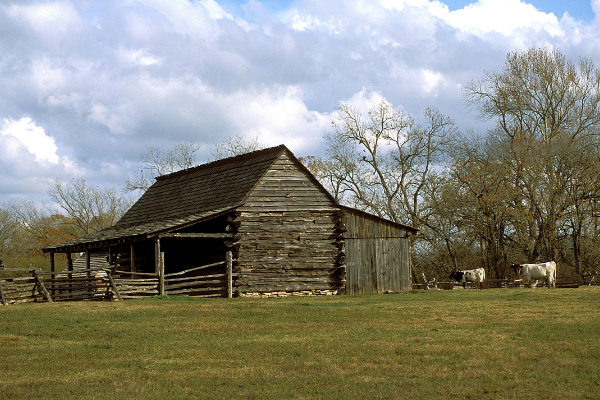
Children can learn about everyday life in the 1800s as they help with laundry, collect firewood, beat rugs and tend to livestock at Barrington Living History Farm.
And engaged storytellers will guide them through it.
Texas Department of Parks and Wildlife hires six interpretive rangers to work on the farm wearing clothes like the ones people wore in the early and mid-1800s. Not only do they do farm work dressed that way, but they can also explain the history and tell stories about people who lived and worked on the farm.
Anson Jones, the last president of the Republic of Texas, owned and operated Barrington Farm with the help of his families five slaves. Jones’ home still stands, but Texas Parks and Wildlife rebuilt other buildings using his records for guidance.
Star of the Republic Museum
Children go on an official scavenger hunt when they enter the Star of the Republic Museum. A museum representative gives them a list of all the treasures that the hunters have to find on this quest, urging them to explore the museum.
The objects could be from any point in Texas history, from early Native American encounters with European explorers to the creation of the Republic to Texas and its annexation in the United States.
Besides the quest, role-playing is expected here. The Pioneer Playroom inside the museum allows children to dress up on a pretend Texas frontier homestead. Children can load a covered wagon or build a log cabin.
Blinn College operates the museum, although it is inside the state historic site that Texas Parks and Wildlife operates. That means sometimes the museum may be closed while the rest of the site is open. The museum is closed for part of the Christmas holiday season, for example. Call before you go.
Fanthrop Inn
About 17 miles from Washington-on-the-Brazos, Fanthrop Inn is another historic site that Texas Parks and Wildlife operates and manages as part of the same complex. The inn was built in the 1840s in Anderson, Texas.
The innkeepers, Henry and Rachel Fanthrop, moved to the area in 1832. They took care of their guests and gave them a safe place to rest on the busy stagecoach route.
Visitors can tour the building. And on some special Saturdays, they can ride a stagecoach hitched to a team of mules to Anderson then back to the inn. The stagecoach is an authentic replica of an 1850 Concord stagecoach. Stagecoach Saturdays are the second Saturday of the month from March through October.
Trails and picnic areas
Walking trails meander through the town of Washington that doesn’t exist anymore. A railroad that bypassed the town in the mid-1850s shifted businesses and residents to other communities such as Navasota, eight miles away.
A portion of the trails are still closed following damage from Hurricane Harvey in 2017, Failor said.
A beautiful, flat area above the Brazos River is a great space to fly kites. Picnic tables and barbecue pits are available, and folks celebrating special occasions can rent a pavilion.
“There are places to get out and run under big pecan trees and listen to water roll down the Brazos,” Failor said.