

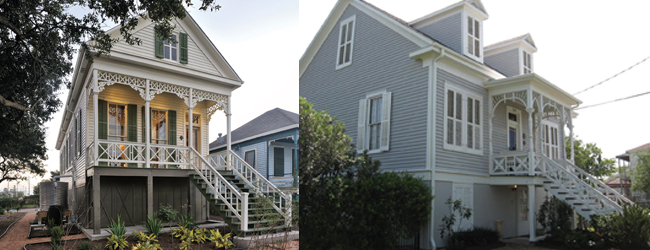
Anyone who has strolled Galveston’s historical residential streets—lined with captivating houses that impose elegance, stature, and dignity—has questioned themselves at least once: what would it take for me to buy a, a forgotten home right around the corner and restore it to its former grandeur? It’s an irresistible fantasy, inspired by the romance of stepping back in time, by the importance of preserving history, and by the thrill of scraping past neglected exteriors to reveal architectural beauty unparalleled by modern residential constructions.
The vision goes hand in hand with a renaissance of sorts that’s been brewing in Galveston ever since Hurricane Ike. The island is misted with an attitude that acknowledges the tragic mess left in the wake of the storm, but at the same time clenches its jaw in a determined effort to make the city better, and to invest in the community. And now, many a committed eye are turning toward the generous supply of neglected historical homes that, with the right care and a lot of work, can be rehabilitated to stand as a testament to the island’s resolve. The result has been a strong upturn in historical home restorations on the island.
Although this attitude is particularly potent among the locals, Houstonians who treasure Galveston for all its charms, and consider it an extension of their own back yards and the hands-down destination of choice for summertime memory-making, also are eyeing these tattered historical residences as candidates for second homes.
This particular brand of second home is not for everyone, acknowledges Matthew Pelz, Director of Preservation and Conservation Services at Galveston Historical Foundation. Pelz recommends that anyone considering a historical home restoration have a personal investment in the project. “It is possible to make money flipping and investing in a house,” Pelz says, “but if money is the only motive, the unexpected problems that occasionally present themselves when you tear into a wall become much more difficult to overcome.” Most people Pelz works with in his position at the foundation want a historical home because they want to live in a house with a lot of character and unique architecture, and a home unlike anything their friends occupy.
Tom Schwenk, a realtor with Galveston-based The House Company (www.thehousecompany.com), is heavily involved in historic preservation, and is chairman of Galveston’s Green Revival Committee. Of the historical homes currently selling in Galveston, most are being purchased as second homes. “We see a variety of people coming in: young professionals like the idea of walking to the corner grocery store or to the beach. Some are people who like the idea of living in these big homes, and want their kids living in more diverse neighborhoods and in a cool community. But most are second- home owners.”
For those who wish to join these ranks and further explore the journey from coveting to ownership, the following points should prove useful.
1. Find the right house. “It has to be one you’re immediately in love with,” says Pelz. “You’re going to be tested, and you can’t be lukewarm in your resolve. Roadblocks will pop up, and you must have conviction in your vision.” Galveston’s historical homes are varied in history, condition, and architectural style—Victorian, mid century-modern, brick bungalows built in the 20s and 30s—there’s something for everyone. It just depends on your personal preferences. “You’ll know it the moment you walk in,” Schwenk says. “Some people like transoms and unfinished woodwork, others like nooks under a stairwell, and still others like a front porch to catch the breezes. When you find it you know it.”
2. Be ready to look at a lot of houses. In general, home buyers wanting a historical home look at many more houses than home buyers wanting a new house. In the latter case, buyers have their set of criteria—four bedrooms, a yard, closet space, for example. “They see five houses, and then they buy,” Schwenk says. The historic home buyer, on the other hand, has a particular idea, and usually recognizes it after looking at 10 or 15 houses.
3. Modern living is different in a historic home. “You have to be practical,” Schwenk says, adding that home buyers will need to determine the importance of central air and heat versus window units and ceiling fans, or the acceptability of using armoires to supplement smaller closet spaces.
4. Location is important. From one block to the next, the character of Galveston neighborhoods changes quite a bit. Pelz recommends that home buyers walk around the streets to find the neighborly appeal that best suits their personalities.
5. Financial relief is available, but finding it requires research, legwork, and thinking outside the box. Although Galveston has no local tax incentives, a home buyer can look to the Department of Energy, which issues tax credits for certain installations, like tankless water heaters. In a definite “outside the box” moment of inspiration, Schwenk installed a radiant barrier on the roof of his own restored home. “I put the vendor’s sign out on the front lawn for two weeks and got 20 percent off the installation,” he says, “and if I refer people, I get even more of a discount.” Pelz was similarly creative in his efforts with restoring Galveston’s Green Revival House,where he worked deals, put up yard signs, and gave lectures to soften the financial blow of restoration costs. Home buyers can also look for low-to moderate-income housing grants through the federal government.
6. Grants are out there, but they are few in number. Historical restoration grants are hard to come by, according to Pelz. “Even for ‘green’ or sustainable work, it’s really tough to find bricks and mortar grant money,” he says, adding that such funding is generally allocated to planning efforts, like feasibility studies, or research on the economics of sustainability. “The best bet is to go to the Grants and Housing office in your city,” Pelz says. “If people come to us in Galveston and we know of something going in the Grants and Housing department, we are happy to help.”
7. Texas offers windstorm exemptions. This means that if a windstorm hits, and a historic home is damaged or destroyed, the homeowner is not required to rebuild it to code, Schwenk explains.
8. Flood insurance varies. In Galveston, the cost of flood insurance is determined based on a number of variables, including how high the house is above sea level, as well as how high the home itself is raised off the ground. Homes that sit 17 feet above ground benefit from less expensive flood insurance. “Most historic homes that were built before there was air conditioning are raised higher off the ground,” Schwenk says, adding that after the 1900 storm, all houses were raised. “People made apartments and storage areas underneath, and that’s what was wiped out,” he says.
9. Insurance agents and appraisers must be versed in historical properties. “Often, when mortgage companies come from Houston or Beaumont, they don’t understand the historical implications,” Schwenk says, “and those implications can make a big difference.”
10. The Landmarks Commission has a say in what you do. Historic neighborhoods carry different restrictions than their modern counterparts. You can do anything you want on the inside, but changes to the exterior are limited. While paint color and roof colors are not specified, fencing and window choices are restricted. “If it can’t be seen from the street, it doesn’t impact the value or integrity of the home,” Schwenk explains. Any other planned reconstruction must be sent through the landmarks commission to get approval. The reason is simple. “Most people who buy historic homes in historic neighborhoods like the relationship to other houses in neighborhood,” Schwenk says, “so if someone puts up plastic fences, that impacts the neighborhood.” Some homeowners are surprised by the commission’s involvement and don’t like the idea that the historic foundation is telling them what to do. “These people don’t get it,” Schwenk adds. “They don’t dictate anything. They simply want to preserve the integrity of the neighborhood.”
11. Budget your home restoration project. Pelz recommends home buyers prepare for between $100 to $150 per square foot, depending on the condition of the house and the level of detail put into the restoration.
12. Consider buying a home that’s already restored. Home buyers can spare themselves a good deal of work this way, and get right down to the task of enjoying ownership. Prices run the gamut, depending on neighborhood, size, etc. Another option is to purchase a home restored by the Historical Foundation, which, as a community housing development organization, can take advantage of grants to make the homes more affordable to the market. Currently, the Foundation has two completely restored historic homes on the market: 3916 Ball ($89,000) and 3801 Winnie ($79,000). These homes do not qualify as second-home purchases, as they have been designated for low-to-moderate income buyers only.
In addition to the rich variety of historical homes in Galveston, Schwenk says home buyers interested in historical homes can benefit from the city’s sense of small community and its wealth of crafts people dedicated to and knowledgeable about historical architecture. “We have the second largest historical foundation in the country, with a staff of twenty,” Schwenk says, “and our preservation resource library is astounding.”
People who renovate homes in Galveston donate unused items to salvage warehouses, where other people can buy anything from transoms to window fashions at incredibly cheap prices. “It’s a treasure chest of stuff,” Schwenk marvels.
Additionally, the Galveston Historical Foundation presents renovation weekend lectures to help people learn how to tackle their restoration projects. “Everyone who buys a home from me gets membership to the Foundation, because I just think it’s a great way to know who’s around to help you,” Schwenk says. Another resource is the Rosenberg Library, which employs spectacular librarians who can help historical home buyers research who lived in the house before them, and a wealth of other archived information that might be useful in the restoration effort.
Schwenk is a true-blue believer in the promise of opportunity Galveston offers to the potential historic homeowner. He bought his Galveston-based historic home in 1987 and has never looked back. “I renovated it completely, live in it, and will die here,” he says.