

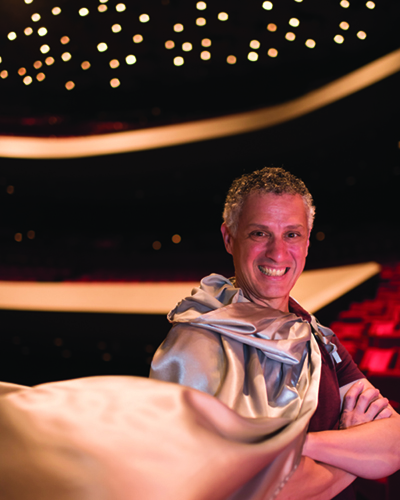
As the Associate Conductor for the Houston Symphony, Robert Franz is a master of artistic leadership, combining all the right variables to captivate Houston families with an inspiring range of creative, educational, and family concerts. We couldn’t wait to talk with this man, someone who embodies Houston’s vibrant creative scene, to learn how he got to where he did, who inspired him along the way, and what excites him most about the arts.
By Sara G. Stephens
HFM: What’s your first memory of a personal music encounter?
RF: When I was in elementary school my teacher, Willa Loescher, took our class to see the Nutcracker. While everyone else was mesmerized by the dancers I was focused on the orchestra. I could see them just a bit, and I listened to every sound they made. I was hooked.
HFM: At what point did you decide to pursue music professionally?
RF: On the first day I took my cello home in 4th grade, I sat in my room for four hours making sounds. At the end of the four hours I went downstairs and announced to my parents that I was going to be a musician. That was the day…nothing has changed since except my instrument is now an entire orchestra.
HFM: Were your parents supportive of this choice?
RF: They loved how connected I was to making music, but they weren’t sure that earning a living as a musician was a real possibility. I was in my late twenties before they were convinced. They are very proud parents now.
HFM: Who were/are your role models?
RF: My first teacher, Willa, was an enormous influence in my life. I didn’t know it at the time, but looking back at having a professional violinist as my elementary school teacher was a big deal. She understood music on a very sophisticated level and I think that understanding of music was a tremendous gift to me. Later in life I began working with a teacher/coach named Joe. He helped me understand being an artist from a completely different perspective. I had developed a physical conducting technique and had studied most of the major pieces in the repertoire, but it was Joe that helped me synthesize it all, and helped me to understand the part I could play as an artist with an orchestra and in my life. Both Joe and Willa are still incredibly important influences in my life.
HFM: Describe for us the journey that led you to the Houston Symphony.
RF: Back in 2007 I was the Resident Conductor of the Buffalo Philharmonic. I had been there three years and I was having a blast. It was the busiest I had ever been as a conductor and I loved every minute of it. One day I received a call from the Houston Symphony asking me to conduct a Linda Ronstadt concert. I had to decline because of another engagement. I had learned early on in my career that going back on a commitment when a better gig comes along was a losing strategy in the long run and ethically not the right thing to do. I hung up the phone with Houston thinking I had killed my chances of working with the orchestra.
The following week I received another call, this time to conduct a Harry Potter concert. I could do it and was excited to meet the orchestra. When I got to Houston I was told that actually the orchestra was looking for a new Associate Conductor, particularly one that would be interested in doing education, family and outreach concerts. Naturally I was intrigued. I was invited back one more time so the orchestra could have one more look at me, and after that second visit they hired me. That was 10 years ago now!
HFM: Of the upcoming year’s concerts, which are you most excited about conducting?
RF: All of them! Every year, as I see thousands of kids and families in Jones hall, I am reminded of how exciting that first visit to a Symphony hall can be.
HFM: What distinguishes a good conductor from a great conductor?
RF: This is a big question. There is a magical combination of talents that a conductor has to possess, first of all. As a conductor you have to understand how the instruments work, how music is put together, and you have to understand the intention of the composer. You then have to create and environment on stage in which the musicians want to make music at their highest possible level. Finally, you have to program concerts in such a way that audiences feel satisfied with the journey you have taken them on. Once you have all of that, then there has to be a chemistry between the conductor and the musicians and the conductor and the audience. When all of those elements align a good conductor becomes a great conductor.
HFM: How do you, as conductor, facilitate teamwork amongst your musicians?
RF: My goal is to create an environment for success. That means as the artistic leader I strive to be objective and impartial with my comments. I begin with listening to the sounds and then responding. Once that trust and environment are created, then I engage the musicians, pushing them to higher artistic levels. If I do my job well, they exceed their own expectations of what is possible.
HFM: What other skills are fundamental to the success of an orchestra and its musicians?
RF: Balancing marketability and artistic integrity is probably one of the biggest challenges. We live in a society that prizes short bits of this and that, and when an audience experiences even a 10-minute piece, not to mention an hour-long symphony, it can be strange and different from their everyday experiences. Our job as musicians is to bridge that gap and provide our audiences with an experience that exceeds their expectations.
HFM: Do you have any other creative or artistic passions?
RF: Yes, I love to remodel homes. I love the idea of making something new, functional, and aesthetically pleasing again. I also highly value my sanctuary. Home for me is a restful, zen place that allows me to recharge. I also love that renovating homes allows you to live in your creation. In music, once the sound has happened it’s gone. In renovating my house, I can observe every day my work.
HFM: What would you say to parents who insist their kids focus more on hard sciences and less on the arts?
RF: Balance! Balance is the key. There are so many things that we learn through the arts that can’t be learned in other areas (The same is true for science, math and languages). I’m not sure why you wouldn’t want to give your child every opportunity in all of those areas to explore and develop. We all learn in different ways, and for some, the arts is a window into a much broader world. The only way you know if that’s your child is if they explore that world.
HFM: How can parents nurture appreciation for the arts in a child who has not shown any interest or ability in this area?
RF: Engagement! Keep engaging your child in the arts. There are so many options. Keep trying until you find the one(s) that resonate. “Art” is not one size fits all, but rather a vehicle for self-expression. As parents, we often take the opportunity to make most situations teaching moments. Imagine if we made most situations artistic moments.
HFM: Even the most gifted and dedicated of students hit that wall that convinces them they no longer want to take the music lessons, dance classes, etc. How does a parent know if this reluctance to continue is a temporary slump/hump, vs. a genuine indication that it’s time to let their child pursue other interests? When do we push, and when do we give in?
RF: I am the last person in the world to offer parenting advice! My three girls are each so different. For one of them pushing is motivating, and for another it’s the opposite. Good luck!
HFM: In another universe, one where you did not take the path that led you to a career in music, what could you envision yourself doing?
RF: I would love to be a lawyer. I do enjoy a good argument…and I like to win.
HFM: How would you describe Houston’s arts scene?
RF: Rich, varied, engaging, full bodied, and forward thinking. I love being part of it.