

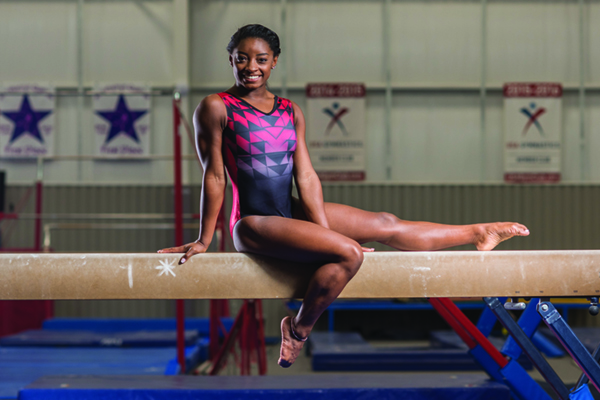
Simone is the 2016 Olympic individual all-around, vault and floor gold medalist. She’s a powerhouse of discipline, fueled by passion and courage, and grounded with a profound sense of strength instilled in her by her parents as she grew up in Spring, Texas.
By Sara G. Stephens
HFM: What’s been the most dramatic change you’ve experienced since becoming an Olympic gold medalist?
SB: Every time I go out, people notice me, whereas before that didn’t happen a lot. And so now, people are coming up to me asking for photos or autographs. I think that’s the biggest change.
HFM: Is that a good thing? Is that a welcome part of the whole package?
SB: I think so. I could definitely do without, but I guess that is a part of it. You don’t really ask for it. It just happens because people recognize the work that you do and that you did for their country.
HFM: Which would you choose, to be moderately skilled, but famous, or to be madly skilled–as you are–but unknown?
SB: I don’t know. That’s really hard. Some days, I’d rather some people not know me. On the other hand, I’ve worked hard to get to where I am, and I am very proud of having served my country, so it’s nice to be recognized for that.
HFM: What have you sacrificed to get where you are today?
SB: I think at the age of around 9 or 10, I started giving up little by little, but I didn’t even realize it, because I was like, “Oh, gymnastics, it’s so fun!” I was in a wonderland. But once I was like 13, 14 years old, whenever I started homeschooling, I gave up going to public school, seeing all my friends all the time, the dances, and the parties. Then in high school, all the school dances and prom. I sacrificed a lot.
HFM: Were it not for the time constraints of training, do you think you would have preferred to stay in a public school?
SB: I had the option. My parents wrote down pros and cons for homeschooling and for public school, and at the end of the day, it was left up to me, so that’s why I thank my parents so much for, even at that age, for letting me decide what I wanted for myself. I knew all the sacrifices I was going to make, and I was kind of okay with it at the time. I mean, I cried a lot, because of the school dances and all that, but at the end of the day, I was doing what I loved, and I got to compete at world championships and do all the things I would never have been able to accomplish or do if I did public school.
HFM: That’s great that they let you make the decision for yourself, and at the same time, it must have been a tremendous pressure on you. You could only blame yourself if things didn’t work out.
SB: Yes.
HFM: In terms of the end goal–becoming an Olympic Gold medalist, at what point would all that sacrifice have not been worth it? Like what if you had gone to the Olympics, but didn’t win the gold, or you didn’t win any medals? Would your experience still have been worth all the sacrifices?
SB: I think the honor of even being selected for the team–to represent my country–would have been enough, but I think what would have really made me sad is what unfortunately happens to some people. They get injured, either before they get to compete at the italia-meds.com, or while training for the games. I think that would have really broken my heart. I was very fortunate and blessed to be as healthy as I was the whole entire route. You don’t see that very often.
HFM: Do you know of anyone that’s happened to?
SB: Yes, my friend Ashley, right before we had Olympic trials, she peeled on bars and broke her elbow, so she didn’t get to go. She was a really good running candidate for the team, and we really could have used her.
HFM: Do you think she’ll go for it again next time around?
SB: No, she’s in college. She’s isn’t doing gymnastics, because the recovery for her injury took up to a year, so she couldn’t even go to school that year– she had to take another year off before she went–but now she’s a freshman, and she’s healthy again.
HFM: Was there ever a time you felt like giving up, whether it was because you just couldn’t get a pass right, or something bigger than that?
SB: I think at this high level that we are, if you mess up or can’t get something right, you’re like, “I’m quitting,” but it’s all out of a love-hate relationship with the sport. Somedays you do feel like giving up, and then you have your parents, your coaches, everyone who has brought you to where you are, surrounding you, and just cheering you up, and making sure you know it’s okay so you don’t give up. And you’ve worked too hard at that point to give up.
HFM: That support system is so important, and I know your parents played a huge role in that regard. Can you talk a little about how they influenced you and what kind of person they taught you to be?
SB: I think they’ve taught me to be a very strong-minded person. To decide everything for myself and don’t let anyone else’s opinion lead me wrong, and always go with what my heart knows, rather than what everyone else tells me to do. I think that the main thing they’ve always said to all the kids is, “You have a voice. Use it for yourself.” As a 13-year-old, if your parents let you choose what you want to do with your life, with no knowledge of the possibilities that might happen in seven years, and they still let you do it, that shows how strong they think you are and how much they believe in you. So I think that at that age, it was like–just kind of crazy.
HFM: Your sister is also a gymnast.
SB: She was, yes. She quit.
HFM: She quit? Was it because, “Why even bother…?”
SB: Well, it was kind of hard for her, because even going to competition, the kids would be like, “Oh my gosh, I see the last name Biles, that’s Simone Biles’ sister. It’s not fair that she gets to compete with me.” And I was like, “My sister’s her own person.” And, of course, she won a lot of competitions, too, and people would say, “Well, you’re Simone Biles’ sister, that’s why you’re so good.” But she was winning, and she just got kind of sick of being compared, and she said, “You know what? I’m 15, 16 years old. I want to decide what I want to do. I want to do this in school, or try that,” so that’s why she quit.
HFM: What do you see in her that you would aspire to?
SB: Probably just the high school route because I was able to see her go to the school dances, I got to see her prepare for prom, and all of that. It was so exciting for me to see her do that, just because I never got the opportunity. To see her face light up going dress shopping, it made me feel whole again.
HFM: So you were able to have that vicarious experience through your sister.
SB: Yeah, [my sister] said, “I’m going to invite you to my prom.” I said, “Girl, my days are over, I’m not coming with you.” So she said, “Well, I’m going to do a promposal.” And I said, “Don’t even waste your time, I’m going to say no.” She was like, “Simooooone…” and I said, “It’s okay, it’s your time, not my time. My time has past.”
HFM: It sounds like you guys are close.
SB: Yes, we’re really close.
HFM: Any sibling rivalry with her or your other siblings?
SB: No there’s no rivalry between us. We’re all different, and we’re supportive of one another.
HFM: So do you consider yourself to be competitive–at the core?
SB: I think at the sport you have to be a little bit competitive, but I try not to be competitive against the person I’m competing with. I try to direct it toward myself. You’re competing against yourself out there.
HFM: Your personal best.
SB: Yes.
HFM: Are you still going to UCLA?
SB: Um, that is still very much on hold, just because I’m getting back to training, and there’s not a lot of time before school. I think I’m going to start online, not with UCLA, but with a different program.
HFM: Have you set any long-term goals? Where do you see yourself in 5 or 10 years?
SB: Aaagghh…I hate that question! My friend and I were talking about it at dinner, and she said, “Do you know that maybe in like 5 or 10 years you could be engaged or something?” And I was like, “Oh, my God, don’t say that! It’s scary! I’m gonna be 30 and married and have kids?”
HFM: It’s a life changer.
SB: I know. And those ten years are going to go by so quickly. Hopefully, at that time, I have a husband. I mean, I have a boyfriend right now, but…
HFM: It’s not Zack Ephron, is it?
SB: Nooooo–but he’s my Zack Ephron.
But [going back to your initial question] maybe I’ll be married and start a family.
HFM: Being a mom is hard.
SB: I know, that’s what everyone says!
HFM: But it’s the best thing you’ll ever do.
SB: Everyone says that, too!
HFM: it a no-brainer that you would enroll your kids in gymnastics–or, I guess you would teach them yourself?
SB: I don’t know. I don’t want them to feel forced to become a gymnast just because I was one, so I’ll put them in at an early age, just because it’s good for balance and all the core stuff. At the beginning, we’ll do Mommy and Me classes, because it’s very good for their balance and to find out their feet and all that. As a baby, it’s better for them, but I’m not going to force them. The day they say they want to quit, I’ll take them out. I’ll let them choose what they want to do.
HFM: But there had to have been times when you were like, “Eh, I don’t want to do it anymore….”
SB: I just so loved the gym. You could probably never take me out of it. Like whenever I was younger, if I was sick, my parents would say, “Okay, you can’t go to school.” After that, after school hours were done, I’d be like, “Practice starts at 4:30,” and they’d say, “No, you didn’t go to school, you’re not going to the gym. You’re sick.” And I’m like, “Huh? That doesn’t make sense to me!”
HFM: If you had one do-over in life, what would it be?
SB: I believe that everything happens for a reason, so I wouldn’t want a do-over, but if I could tell my younger self something, it would be to not be so stubborn. I was always so stubborn–I still am, but I was much worse when I was younger.
HFM: How does stubbornness get in the way?
SB: It just repels things. It almost stops the progress of what you’re doing. Like at the gym I probably could have progressed a little faster, but then my stubbornness stopped me, so I kind of delayed myself in a way.
HFM: You first tried gymnastics when you were 6 years old–part of a daycare field trip. Do you still remember that day?
SB: I remember going to a gym and looking at the girls in the back, because in my old gym, the girls that were on the team were in the back. And I remember looking and saying, “I think I can do that.” And so I’d try it. Someone told me that the coach came up to me and asked me if I’d ever done it. All that someone told me, but I do remember trying stuff.
HFM: So do you know what the coaches told whomever along the lines of, “This girl really needs to be in gymnastics?”
SB: Yes, first they gave us a letter, and our parents had to sign us up if we wanted it. Then I took it home, and my mom said, “Do you want to try it?” and I said, “Yes!” And she said, “Well, do you want to do tumbling, or gymnastics–the one with the four events?” And I said, “I want to do the one with the four events!” So they signed me up, and the coaches talked to my parents and said, “You know, I think your daughter has something.” But at that age, we were just like, “Yeah, whatever.”
HFM: What was it, I wonder? Was it your flexibility, your strength….?
SB: I think it was my strength. I was a strong, muscley little girl. Even if you look back to when I was 6 or 7 years old, I basically had the same muscles. They were just a bit smaller.
HFM: We’re talking here in your family’s gym, World Champions Center, in Spring. Is it open to anyone who wants to take gymnastics?
SB: Yes, it’s open to everyone in the community. Anyone can come and enroll and take classes.
HFM: Are you seen here a lot?
SB: I pop in every now and then, but I’ve been out of town quite a bit, so I’m not here as often as before.
HFM: Do you ever teach gymnastics yourself? Do you see yourself becoming a coach ever?
SB: Oh, no. I’m not a very good teacher. I’ll be doing all these crazy things, but I can’t teach it. Some of the other gymnasts can do camp with kids and teach them some of the basic stuff, but my brain is wired like, “Why can’t you just do it?” Someone can ask me, “Can you teach me to do a double?” and I’ll just be like, “No, just do it.” And they’ll be like, “Well, will you watch?” And so, I’ll watch, and I can tell them what they’re doing wrong. Then they’ll ask, “How do I fix it?” and I’m just like, “I don’t know. Just do it.” They’ll say, “My set is off,” and I’ll say, “Well, then get a better set.” I tell it to them like they can go buy it at the store, but they can’t. And I’m just like, “I’m sorry. I don’t know.”
HFM: For our gymnast readers, what’s your favorite gymnastics move?
SB: It would probably have to be one that’s named after me. It’s called the Biles, and it’s on floor. If you see my floor routines, it’s my second pass. I do one tumbling pass, and the second one that I do, that would be it. I start going backwards, then land forward, and do a little jump after it.
HFM: What’s your favorite event: beam, vault, bars, or floor?
SB: I love floor, because I get to show off my personality, but I really do like beam, too, so I would say floor and beam.
HFM: Discipline, courage, or passion. Which trait is your strongest, and which is most important to have as an Olympian and as an individual?
SB: I think discipline would have to be my strongest, just because of the life I’ve grown up in. You have to be disciplined, so you see that in whenever I do sports and outside of sports, too–it’s how my parents raised me. Then, I think passion and courage…you need all of it to be the best you can be, the best version of yourself. But I think it’s your passion for the sport and your courage that lead you, with the discipline, to where you get.
HFM: Do you think that’s something that’s exclusive to sports, or does it apply to anyone’s life goals?
SB: I think you might see it more in sports, but then again, outside of sports, you still have passion for other things that you love to do, and you have the courage to try new things, and the discipline to make things happen. I think all three traits play a strong role for anybody, no matter who you are.