
A pictorial exploration of Houston’s growing love affair with sustainability
By Sara G. Stephens
ART

Jeremy Underwood is a steward for the Houston environment—but not in the way you might think. As a nature photographer, Underwood treks across the city, seeking inspiration for his photos. Sometimes these scouting missions present a disappointing underbelly of pollution. Rather than turning his lens elsewhere, Underwood sets down his camera and focuses his efforts on transforming the rubble into a piece of thought-provoking art. He then photographs the scene and adds it to a landscape collection he calls, “Human Debris.” For more on Underwood, go to https://jeremyunderwood.com/.
BIKEWAYS

Houston is rapidly becoming a city of cyclists. With a nod toward this trend, the city offers a 345-mile interconnected bikeway network spanning across 500 square miles of the city. The network includes bike lanes, bike routes, shared lanes and bayou trails, rails to trails, and other urban multi-use paths. Recently, swamplot.com updated readers on an important new bikeway, The Lamar Cycle Track, which represents Houston’s first two-way fully protected bike lane. “The track provides a nearly three-quarter-mile connector from Sam Houston Park to Discovery Green, and provides a safe, well-defined path for users between the Buffalo Bayou Trails and the Colombia Tap Trail,” the blog reported.
RESOURCES FOR GREEN LIVING

Open since Earth Day, 2009, the GBRC is located in the corner of the LEED certified gold Houston Permitting Center. Visitors can see a demonstration vegetated roof irrigated with AC condensate and take a tour of the center’s rooftop array of solar panels and four wind turbines. They also can browse over 50 displays to familiarize themselves with green building technology and materials. The GBRC is open Monday-Friday 8 am – noon and 1 pm – 5 pm, and second Saturdays of the month (except December), 10 am to 2 pm. For more information, visit www.codegreenhouston.org.
WILDFLOWERS

50 acres of parkland and esplanades are in bloom across Houston thanks to Mayor Bill White and volunteers who helped the Parks Department sow wildflower seeds in the fall during the Second Annual Lady Bird Johnson Tribute Planting.
GREEN MARKETS

The City Hall Farmers Market welcomes Houston families to enjoy locally prepared ready-to-eat or packaged to-go foods, pick up farm-fresh weekly groceries and at the same time support sustainable food, all amidst Houston’s dramatic downtown urban setting. The City Hall Farmers Market features more than 30 vendors, including local fresh produce grown by local farmers, cheeses, breads, roasted coffees, and a variety of prepared meals, as well as food trucks. The 2015 Spring Market runs every Wednesday, at Hermann Square in front of City Hall, from 11:30 am to 1:30 pm.
WORKPLACES THAT INSPIRE LIFESTYLES
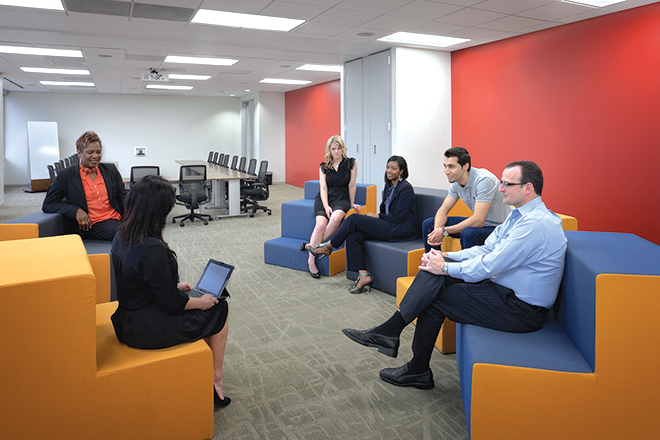
“Many Houston families bring sustainable behavior like recycling and conservation of resources home from their workplace,” says Tony Keane, President & CEO of the International Facility Management Association (IFMA). “This is growing more common because environmental stewardship has become a mainstream business objective, in terms of both green technology and employee behaviors. As people see first-hand the advantages sustainability has for productivity, health and costs at work, they are finding ways to achieve those same benefits at home. When we train facility management professionals how to achieve sustainability, they in turn train the occupants of those buildings who bring those lessons home to their families. It’s trickle down sustainability.”
TRANSPORTATION

The proposed, 200-mph Texas Central Railway bullet train, to connect Houston and Dallas, will increase local tourism, cut carbon emissions, and create thousands of jobs. The project’s official website, www.dallashoustonhsr.com, posts official statements, maps and documents, and explains how the public can submit input directly to the government agencies overseeing the regulatory process. It’s a great opportunity to educate kids about how such monumental efforts progress.
ARCHITECTURE

This collection of gleaming white gable roof homes is part of the new wave of sustainable design in Houston. Designed and built by Matthew and Tina Ford through their company Shade House Development, the Row on 25th is a series of houses built with a number of energy-efficient strategies, like daylighting, radiant barrier house wrap on the roofs, and heat-reflecting shingles to minimize solar heat gain. The ducts were installed in the basement rather than the roof to keep the cool in the house.
INSPIRATION
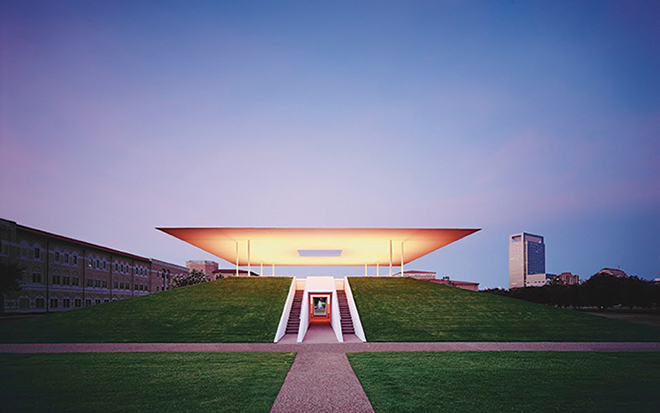
James Turrell’s Twilight Epiphany Skyspace is a 100-square-foot grass berm topped with a 72 square foot floating canopy. The Rice University installation is equipped with a complex arrangement of rooftop LED lights that interact with the natural light present during sunrise and sunset, beckoning students and visitors to contemplate the magnificence of nature. The rooftop LED light sequences are carefully arranged according to the solar calendar so that light and music shows, available six days a week in summer, never occur at exactly the same time.
ELECTRIC CHARGING NETWORKS

Houston gets credit for landing the first privately funded EV charging network in the U.S., developed by NRG Energy. The City of Houston has partnered with eVgo, ECOtality, GRIDbot and Coulomb Technologies to study, plan, and install electric vehicle charging stations (EVSE). Visit https://www.greenhoustontx.gov/ev/findastation.html to locate all the charging stations in the Houston area. And go to NRG’s eVgo website at www.nrgevgo.com to check out special offers.
UPCYCLED LANDMARKS
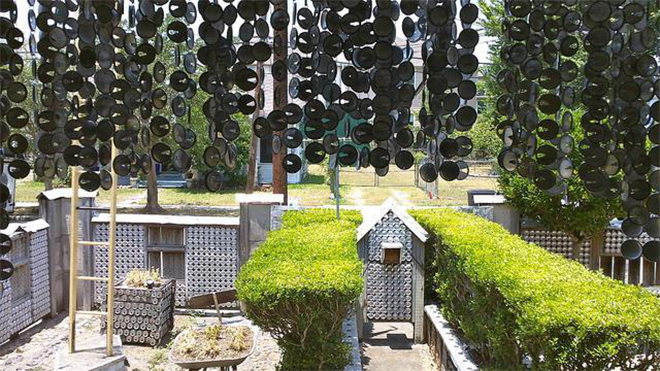
A Houstonian’s labor of love, the Beer Can House teaches visitors an important lesson: Let nothing go to waste. Born during the Great Depression, Milkovisch was taught at a young age to always reuse and repurpose whatever was brought into the house. Saving old cans in the attic, he got the idea to repurpose them into aluminum siding, carefully cutting and flattening each can by hand. He crafted garlands of beer can tops to create a shimmery canopy for the house. And he repurposed empty beer bottles into “stained glass.” Families are welcome to visit this lovable Houston landmark at 222 Malone St. each weekend from 12pm – 5pm.
EDUCATION

Houston-based Council for Environmental Education (CEE) is dedicated to teaching educators and their students how to think, not what to think, about the environment. It serves as headquarters for several programs that connect pre-K through 12th grade educators to materials and training on getting kids outdoors and learning in nature. CEE works closely with partnering agencies, public schools, Head Start centers, and afterschool providers to build content about wildlife, water, and the ecosystem into school curriculum and out-of-school programing. CEE’s programs use hands-on learning activities that help children from ages 3 and up develop environmental literacy and become environmental stewards. Houston educators can find out more about CEE programs at https://councilforee.org/.
BUFFALO BAYOU

Ever since the Allen Brothers founded Houston in 1836, Buffalo Bayou has played a critical role in the evolution of the city. In addition, it has served as a major artery in the network of waterways flowing from west to east into Galveston Bay. Currently, Buffalo Bayou Partnership (BBP) is leading the $58 million Buffalo Bayou Park project that includes major destinations, natural landscaping, footpaths, trail lighting, water features and pedestrian bridges. The entire park will be complete in early summer 2015. BBP invites Houstonians of all ages to donate their valuable time and energy to restoring and protecting Buffalo Bayou’s parks and trails. Contact Crystal Ortiz, Volunteer Supervisor, at cortiz@buffalobayou.org or 713.752.0314, 713.752.0314 ext. 206 to get started.